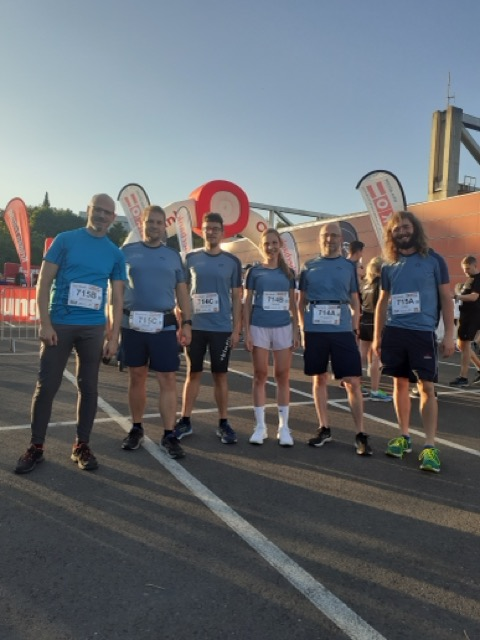
Bachelor Thesis – Application of Scheduling Algorithms in the Industry
Manuel Schlenkrich wrote his bachelor's thesis with RISC Software GmbH on scheduling and optimization in industry.
mehr erfahren
Master’s thesis on
Virtual Cutting System
Master’s thesis on
Virtual Cutting System
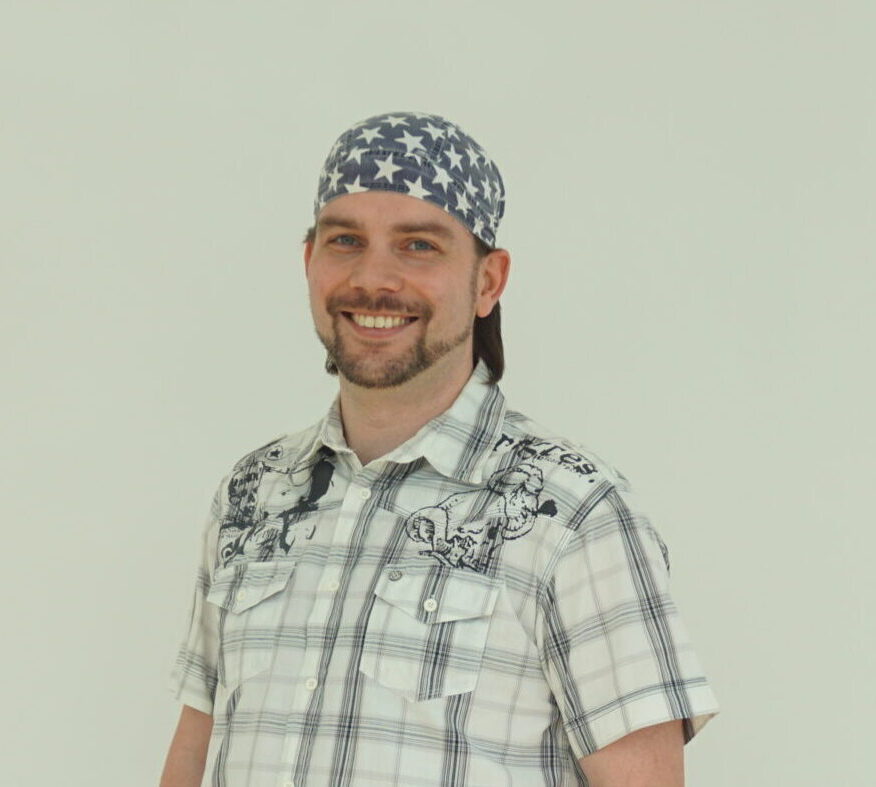
Thomas Kniplitsch studied Software Engineering at FH Hagenberg and developed a virtual cutting system for the two outer meningeal layers in his master’s thesis. He was supervised by Dr. Wolfgang Fenz from the Medical Informatics Research Department of RISC Software GmbH.
Thomas: The aim of the master’s thesis was to develop a virtual cutting system for simulated dura mater and arachnoid, the two outer meningeal layers. Since the dura mater is less intertwined, the initial focus was on it. A mass-spring-damper model was chosen as the physics simulation, as it can handle topology changes at runtime better than, for example, a finite element model, and is also simpler in structure. A triangle-based surface mesh was preferred over a volumetric variant as the simulation topology, since meninges have a relatively small volume in relation to their surface area.
When analyzing existing cutting algorithms, it was found that most systems either change the geometry of the physics elements and thus their behavior, or represent cuts with insufficient precision. A hybrid approach, which partially decouples the rendered surface from the geometry of the physics simulation, was chosen as a starting point, but the existing algorithms were deemed insufficient. This led to the development of a new cutting algorithm, which forms the core of the master’s thesis. This allows for a balancing of cutting precision and complexity of the rendered elements via parameters, with similar physics simulation performance as other hybrid approaches.
In addition to the cutting algorithm, data structures were developed for partitioning the simulation area and merging points, which should also prove useful outside the cutting algorithm.
Supervisor Wolfgang Fenz: The topic was chosen with the aim of later integrating the cutting algorithm into the virtual component of the MEDUSA training simulator for neurosurgeons, to simulate the free dissection of brain aneurysms, which includes cutting meninges. Both the (visual and physical) realism and the real-time performance of the method are significant challenges. During his master’s thesis, Thomas Kniplitsch delved deeply into the complex topics of mesh cutting algorithms and the anatomy and physical properties of meninges, demonstrating great skill in both researching the state of the art and in implementing and developing new efficient data structures. It is particularly gratifying that a paper based on the results of this work has already been accepted for a presentation at an international conference.
Thomas: I became aware of RISC Software GmbH through the FH Next career fair, where they had an exhibition. The field of medical informatics particularly appealed to me. This led to me completing a professional internship at RISC Software GmbH during my bachelor’s studies. After completing the internship, I was hired as a part-time employee, which is how I became involved with the Medusa and Ares projects. Since master’s theses are also conducted in these areas, it was a natural fit for me. My supervisor was also my colleague, with whom I had already worked, which was, of course, super practical and pleasant. Furthermore, I was allowed to take months of vacation or compensatory time off during my study periods, for which I am very grateful.
Thomas: Since I have only had positive experiences at RISC so far, I would like to continue working here. I am very satisfied in the Medical Informatics department; I particularly value the pleasant working environment and flexible working hours. Furthermore, I find working in medical research to be very meaningful, so I hope to be able to work here for a long time to come.
We’ve received your documents and will review your application carefully.
As soon as we have feedback for you or need any additional information, we’ll get in touch.
Thank you for your interest – we’re excited to learn more about you!
In the meantime, feel free to pass the time by discovering a bit more about us 🙂