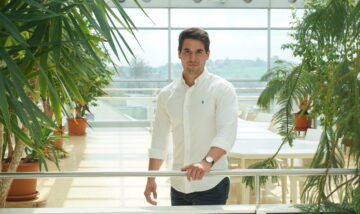
Sebastian Schmalzer studied technical mathematics at JKU Linz and wrote his bachelor thesis entitled “Methods for Solving the Inventory Routing Problem.” He was supervised by DI Dr. Michael Bögl from RISC Software GmbH and Assoc. Univ.-Prof. DI Dr. Wolfgang Windsteiger from JKU (RISC Institute).
What is your Master’s Thesis about?
Sebastian: My bachelor thesis deals with possible solution methods for the Inventory Routing Problem. This is an optimization problem in logistics and combines tasks from the areas of inventory management and tour planning. It is about finding a delivery plan that provides information about when, in what order and with what quantity a supplier should supply its customers with its product. In addition, the delivery plan must comply with various capacity restrictions and should cause the lowest possible total costs. These total costs are made up on the one hand of the transport costs and on the other hand of the storage costs, both at the supplier and at the customers.
At the beginning of my work, I carried out an extensive literature search to familiarize myself with the topic and to get to know the different variants and characterizations of inventory routing problems. Subsequently, in the course of my bachelor thesis, I dealt with two concrete methods for solving such problems: On the one hand, I treated an exact solution method by formulating an integer linear optimization problem and solving it using a branch-and-bound algorithm. On the other hand, I also dealt with a metaheuristic method with a tabu search. I implemented these two methods in C# and tested their performance using benchmark instances in order to gain information about their strengths and weaknesses. It was very exciting to see, among other things, when the exact approach reaches its limits or how differently the metaheuristic tabu search reacts to different characteristics in the input data.
What Were the Challenges of the Topic?
Supervisor Michael Bögl: This problem is also known as Vendor Managed Inventory and is a method of managing inventories in supply chains. This type of inventory management is used, for example, in retail. The challenge in solving such a task is the necessary broad knowledge from the fields of supply chain management, mathematics and computer science. In order to solve such problems, high creativity is required in the conception and development phase, and accuracy and combinational skills are required in the analysis phase. Sebastian combines all of this; he has implemented this challenging bachelor thesis in a very good, creative and innovative way.
Karoly, What Skills Did Christian Show in the Course of His Master’s Thesis, What Was Solved Particularly Well?
Karoly: We supported Christian Huber from the provision of the software package that was needed to read and process the graph of the Austrian road network, to a list of literature. In regular meetings, we followed the progress of his work and discussed his emerging questions. The first thing I would like to emphasize about him, however, is his ability to work independently and alone. He succeeded in familiarizing himself with the given software framework, he showed a good understanding of the relevant state-of-the-art research and successfully put the theory into practice with our guidance.
Christian was very motivated and enthusiastic about the chosen topic during our collaboration, which was also a key factor in the successful completion of his bachelor thesis.
How did you come to write the thesis at RISC Software GmbH and what was the supervision and the process like?
Sebastian: I first became aware of RISC Software GmbH through the JKU career day. I then applied for a summer internship in the summer of 2020, at which point I had completed four semesters of my bachelor’s degree. Towards the end of this internship, I was asked if I would be interested in writing my bachelor thesis here. Everything then went very smoothly, even despite the occasional lockdowns, and we were able to agree on a topic in the following winter. Prof. Wolfgang Windsteiger took over the supervision from the university and Michael Bögl from RISC Software GmbH. At initial meetings in a group of three, we concretized the task and defined the scope of my bachelor thesis, so the work could start. In my opinion, the further process then developed into a very good symbiosis: While Michael was always at my side with advice and support, especially in technical matters, Wolfgang always provided me with valuable input regarding the structure and implementation of a mathematical work like this. All in all, I am very grateful for the conscientious supervision.
In which fields of activity would you like to work in the future? What are your plans for the future?
Sebastian: My goal in the near future is definitely to successfully complete my master’s degree in industrial mathematics. Through my bachelor thesis, I was able to gain a good practical insight into the fields of combinatorial optimization, and I particularly liked the many different refinements. From that point of view, I can certainly imagine being active in this area.
We’ve received your documents and will review your application carefully. As soon as we have feedback for you or need any additional information, we’ll get in touch.
Thank you for your interest – we’re excited to learn more about you! In the meantime, feel free to pass the time by discovering a bit more about us 🙂