Master’s Thesis on Interpretable
Detection and Inference
of Personal Data
Disclosure on Social Media
Master’s Thesis on Interpretable
Detection and Inference
of Personal Data
Disclosure on Social Media


Master’s Thesis on Interpretable
Detection and Inference
of Personal Data
Disclosure on Social Media
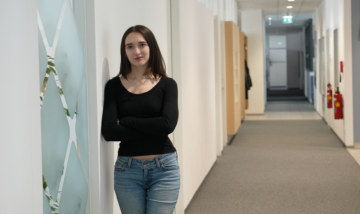
Yvonne Marneth studied Software Engineering in her Master’s program and wrote her master’s thesis titled “Interpretable Detection and Inference of Personal Data Exposure on Social Media”. She was supervised by DI (FH) Stephan Leitner on behalf of the company and by FH-Prof. PD DI Dr. Stephan Winkler on behalf of the university of applied sciences.
Yvonne: In short, my master’s thesis deals with sensitive information that social media users knowingly or unknowingly publish in their posts, and that can be extracted by third parties using automated analysis methods. Especially with modern AI-supported methods that, for example, use large language models to analyze and interpret large volumes of data, the original sources of individual pieces of information are often no longer traceable. The system I developed looks at a person’s public posts across multiple platforms to find and interpret sensitive attributes and make them visible to users in a chain of evidence.
I started by researching existing approaches to privacy exposure analyses, which, however, mostly look at individual aspects—such as detection, inference, or interpretability—in isolation and rarely deliver results that are consistently traceable and verifiable. Building on that, I developed a modular pipeline for German-language social media profiles: public posts from a requested profile are collected, a pre-trained named entity recognition component identifies and categorizes potential personal information in them, and an LLM-based reasoning step combines these clues into specific sensitive attributes. In each case, a rationale, the clues used, and their source posts are included. I evaluated the NER component quantitatively using precision, recall, and F1 score, and additionally tested the reasoning component qualitatively on real profiles.
Yvonne: For many people who use social media every day, it is difficult or impossible to assess what information third parties can extract from the content they publish. With the development of language models that can also process natural language and recognize contexts through pre-trained knowledge, this challenge is becoming ever greater. The biggest challenge in this problem was building a suitable data basis for the trained models. Social media posts largely consist of colloquial language, abbreviations, references, and dialect. With German content, it is also particularly common for German to be mixed with other languages, for example through anglicisms. All of these cases need to be covered in the data basis.
DI(FH) Stephan Leitner: Social media is an integral part of everyday life for many people. Users often reveal more than they realize: hints about employers, place of residence, or family are publicly visible and can be specifically analyzed by third parties. The problem is less the individual post than the sum of many seemingly harmless pieces of information, from which, for example, habits or political views can be inferred. For companies, this is a tangible security risk. Attackers use publicly available information about employees to write deceptively authentic phishing messages or to impersonate an executive in so-called CEO fraud. IT security departments therefore want to understand what attack surface their own workforce’s social media profiles provide. The topic is also relevant for banks and insurers in the fight against identity theft, as well as for data protection officers who must prevent personal data from being unintentionally published via company channels.
The challenge is, first of all, that personal data in social media posts is rarely clearly structured, but instead is hidden in everyday language, abbreviations, or dialect. Even more difficult is drawing conclusions from many scattered individual pieces of information—the same conclusions an attacker would draw. On top of that, there is a fundamental dilemma: to train such a system, you would need real personal data, which, for data protection reasons, must not be freely used. Artificially generated training data is one way out, but models trained on it often perform significantly worse on real posts. For practical use, it is also crucial that every conclusion can be justified in a traceable way and tracked back to the original posts. Only then can experts review the results and detect incorrect inferences made by the AI.
DI(FH) Stephan Leitner: As part of her master’s thesis, Ms. Marneth demonstrated that she can independently structure and technically implement a multifaceted topic that is relevant both socially and economically. Instead of looking at detection, inference, and traceability separately, she combined these aspects in a modular, multi-stage pipeline. This required a broad range of skills: from collecting and preparing public social media data, to training models for detecting personal data, to the targeted use of large language models for inferring sensitive information. It is also noteworthy how she dealt with the lack of usable real training data and searched for solutions using synthetic and combined training strategies.
Yvonne: When I started my master’s program, I had already been employed at RISC Software GmbH for several years since completing my bachelor’s degree. My plan to complete the master’s program and continue working in parallel was supported by the company from the very beginning. This support was also evident in selecting a suitable topic within the company, as well as through occasional reviews with subject-matter experts in the company, who always gave me valuable feedback on my approaches. Within his supervision, Prof. Winkler enabled me to work independently on my solutions, and additionally supported me through regular strategic meetings in which we jointly identified weaknesses in the approaches so far and adjusted course when needed. This professional exchange was often crucial for the progress of the work, and I found the mix of independence and targeted feedback very valuable.
Yvonne: After working for a few years in classic web development, the master’s thesis opened up a new field for me in the form of NLP applications and AI-supported service architectures. I hope that I can integrate this knowledge into my day-to-day work in the future in order to continue creating efficient solutions for our partners. I could also imagine pursuing a PhD in this area in the coming years.




We’ve received your documents and will review your application carefully.
As soon as we have feedback for you or need any additional information, we’ll get in touch.
Thank you for your interest – we’re excited to learn more about you!
In the meantime, feel free to pass the time by discovering a bit more about us 🙂