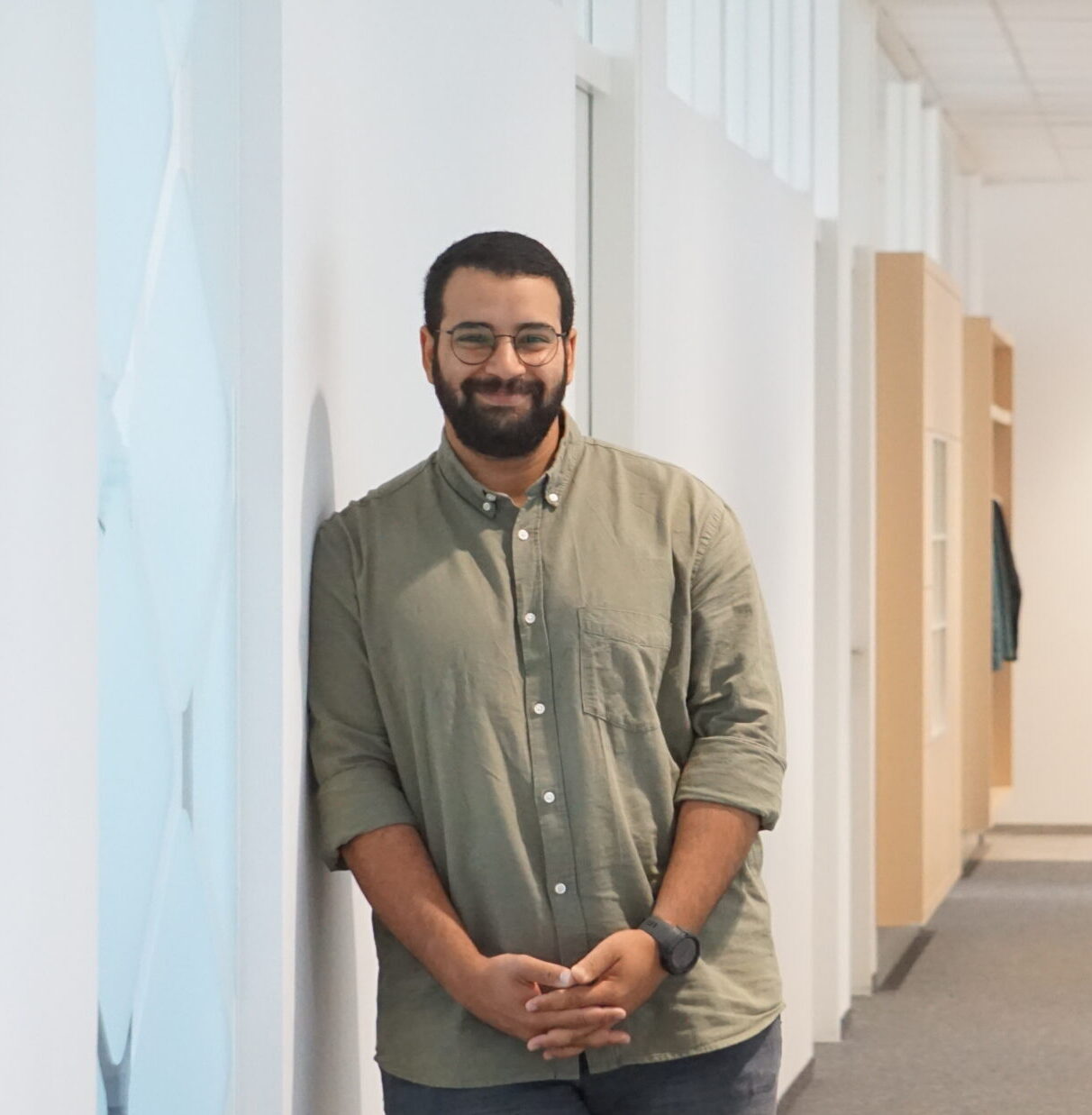
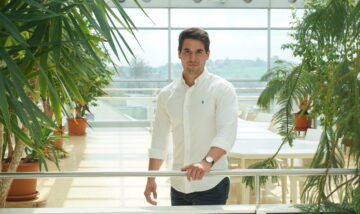
Ahmend AlShenoudy studied Artificial Intelligence at JKU Linz and was already working as an intern at RISC Software GmbH when he found the ideal topic for his master’s thesis. It tackles the challenge of training medical machine learning models with limited data using generative models, specifically for brain tumor segmentation.
What is your master’s thesis about?
Ahmed: In a nutshell, my thesis attempts to address a prevalent issue within the medical field, that is learning with not enough data. Machine learning models mostly depend on annotated large datasets for training, which can be prohibitively expensive to obtain in the medical domain. We address this by employing state-of the-art generative models, as they do not require any annotated data.
Our main intuition is that if a trained generative model can generate realistic images, it implies an inherent comprehension of the content of these images. Hence, we apply this for brain tumor segmentation, operating on the same assumption that if a generative model can generate MR sequences, it possesses an understanding of the content of those generated sequences, including tumorous regions. We exploit this knowledge for the downstream task of brain tumor segmentation. Our results demonstrate a substantial reduction in the quantity of required data, all while maintaining comparable performance to methods that rely on significantly larger amounts of annotated data.
Where are the concrete problems in real use cases? What were the challenges of the topic? What skills did the person supervised demonstrate in the course of the master’s thesis, what was solved particularly well?
Supervisor Erich Kobler: Mr. AlShenoudy’s master thesis aimed to develop a generative model for jointly synthesizing various MRI sequences of the brain and utilizing the learned representations for semantic segmentation of tumorous regions. Ultimately, Mr. AlShenoudy showcased that a substantial reduction of the labeled training data can be achieved without noteworthy performance decreases.
Throughout the thesis, Mr. AlShenoudy was very committed, independent, goal- and detail-oriented. Despite the limited computational resources, he managed to perform detailed analyses of the related work and develop a sophisticated improvement.
How did you come to write the paper on RISC Software GmbH and what was the supervision and process like?
Ahmed: It all started when I joined as an intern, I saw an internship offering during JKU’s virtual career fair. Over time, this evolved into a part-time position while I pursued my studies. As I approached my final year at university, my unit leader generously offered me the opportunity to conduct my thesis research at RISC Software. He was highly supportive and encouraged me to find a research topic aligned with our field.
In my search for a relevant thesis topic, I explored various options with different institutes at JKU. It was during this exploration that I met Dr. Erich Kobler, and our discussions proved highly productive. We discussed a common problem in the medical domain, namely, data scarcity. Dr. Kobler recommended a paper that was still under review, which held the potential to address this issue and served as an excellent starting point for my research. This paper perfectly aligned with our research unit’s focus. My initial work on this topic took place during my Practical work in AI at JKU, which later contributed to the subsequent refinement of my research question.
I consider myself fortunate to have combined my work at RISC Software with my studies at JKU. My research was supervised by Dr. Kobler, where his ideas and insights have been instrumental in shaping my research direction. At RISC, I received exceptional support and guidance, further enriched by the extensive expertise of my colleagues within the research unit.
In which fields of activity would you like to work in the future? What are your plans for the future?
Ahmed: I would love to keep working in medical research. In fact, I consider myself fortunate to have transitioned into full-time employment with RISC Software, where I can grow my skills, knowledge and experience in a field I enjoy. As I look ahead, I see myself focusing on growing my skills, while keeping an open door for starting a PhD in the upcoming few years.
Wir haben deine Unterlagen erhalten und sehen uns deine Bewerbung in Ruhe an. Sobald wir eine Rückmeldung für dich haben oder noch etwas benötigen, melden wir uns bei dir.
Danke für dein Interesse – wir freuen uns darauf, mehr über dich zu erfahren! In der Zwischenzeit kannst du dir die Wartezeit gerne versüßen und noch ein bisschen mehr über uns erfahren 🙂